For the last fifty years or so I have used the Bury shoe repair shop owned by the Curry family. This business has thrived in the town for over 180 years and is now situated in Cannon Street. On the walls of the shop there are many old photographs. One shows three generations of shoe-menders:
Shoe-makers shops were a common sight in both town and country during the 19th century, though in small villages like Felsham the cobbler's workshop was probably in one corner of his small living room. A bench, chair and a set of shoe-making tools was all that was required to set up in business.
The Museum of East Anglian Life at Stowmarket has an excellent re-construction of a shoe-mender's workshop representing the trade at the beginning of the 20th century:
In 1841 Felsham had three shoemakers which suggests that there was considerable demand from the local population, which even if you include Gedding, never exceeded more than six hundred people throughout the 19th century. Their names were John Green, William Gill and William Cornelius. The first two lived on Upper Green, while Mr Cornelius had his workshop on the south side of The Street.
 |
| Map of Felsham village centre showing where the shoemakers and other craftsmen lived |
Ten years later, Felsham still managed to support three shoemakers. Joseph Gladwell, living on The Street, and Henry Aves, living on Upper Green, were both aged thirty-one and described themselves as Master shoemakers. The third shoemaker was John Green.
By 1861, John Green had left the village. (He was to die in his native village of Haughley in 1875 aged 73). Joseph Gladwell and Henry Aves were joined by a James Last who was described in the Census Returns for Felsham as a "tailor and shoemaker of 17 acres employing one labourer and a boy." I am rather tickled by the fact that a shoemaker should be called LAST because this, of course, was the name of the 'model' on which the craftsmen worked or shaped the boots and shoes.
James Last hailed from Whepstead and the Census recording his household in 1861 reveals that in addition to employing a labourer and boy, he had an apprentice in the tailoring side of the business.
James
|
Last
|
Head
|
45
|
Tailor and shoemaker of 17 acres employing 1 labourer and boy
|
Whepstead
|
Anne
|
Last
|
Wife
|
46
|
|
Earls Colne
|
Clara
|
Last
|
Daughter
|
8
|
Scholar
|
Cockfield
|
John
|
Poole
|
Apprentice
|
14
|
Tailor's apprentice
|
Drinkstone
|
Mary
|
Steward
|
Boarder
|
70
|
Living on Annuity
|
Stanningfield
|
Ruth
|
Crick
|
Servant
|
15
|
House Servant
|
Cockfield
|
It is interesting to note that Mr Last was first and foremost a tailor and that the shoe-making business was perhaps only a sideline. I wonder whether this over-lap between trades was a general feature of the time and whether craftsmen working in leather developed a variety of skills which may have included saddlery and harness making? James Last was also a small-holder of 17 acres and it would be interesting to know how far the farming of this land contributed to his over-all income. Moreover, the mention of an elderly boarder staying in the house suggests that he would have been in receipt of some 'board and lodge' income though she may have been a relative. That the family was able to employ a young house servant suggests that William Last was comfortably-off.
The shoemakers of Felsham contributed to the general self-sufficiency of the village in early Victorian times before the advent of factory-made shoes, sold via pedlars and village shop-keepers, began to undermine their monopoly. Who were their customers? Were they only farm labourers and their families or did their clientele include farmers and other members of the rural middle classes?
James Last continued as one of the Felsham shoemakers for many decades and the final mention in the official records show him residing in the village Townhouse in 1891. William Last [his son?] continued the trade of shoe-maker in the village at least until 1911 when he was about seventy years of age. He may have lived in one of these cottages on Upper Green:
 |
Undated photo of Upper Green but probably taken in 1910
or thereabouts |
Shoemakers are seldom mentioned in the Felsham Church records which makes me wonder whether they were non-conformists. Further research is required including an examination of the records for local Baptist and other dissenting religious organisations for this period.
Religious Dissent is one thing, political dissent is quite another. Politically, it is unlikely that our village shoemakers were of a dissenting frame of mind for deference to the 'powers that be' was deeply built into local rural society; nevertheless, it has been convincingly argued that, traditionally, shoemakers adopted a radical outlook on life.
Eric Hobswbawm, one of the great British historians, commented on the proverbial radicalism of shoemakers in his excellent book, "Uncommon People" (Abacus, 1998), and points out that they were very active in the Chartist movement:
... in 1830 the average riotous parish had from two to four times as many shoemakers as the average tranquil one. [p.27]
Shoemakers were often thought of as being intellectual:
“A cobbler once in days of yore/Sat musing at his cottage door./He liked to read old books, he said,/And then to ponder, what he’d read.”
The shoemaker’s reputation as popular philosopher and
politician predates the era of industrial capitalism and extends well beyond
the typical countries of the capitalist economy. The patron saints of the craft, Crispin and Crispinian, were
martyred because they preached unorthodoxy to their customers in the workshop
in Soissons in France.
The shoemakers of the larger Suffolk villages and in the towns like Stowmarket may well have had a more radical streak. Certainly, in the industrial north:
He is, typically, a cobbler, an old man and the sage of his
industrial village: ‘He has a library that he rather prides himself upon. It is a strange collection… there is the …
“Wrongs of Labour” and “The rights of man”…. (EP Thompson, “Village Politician”, 1849)
Perhaps the most plausible explanation of the trade’s
intellectualism derives from the fact that a shoemaker’s work was both
sedentary and physically undemanding.
Probably it was physically the least taxing labour for men in the
countryside. As a result small, weak or
physically handicapped boys were habitually put to this trade.
In this respect, EP Thomson mentions a certain John Pounds:
John Pounds
(June 17, 1766 - January 1, 1839) was a teacher and altruist born in Portsmouth, and the man most responsible for the creation of the
concept of Ragged schools. After Pounds' death, Thomas Guthrie (often
credited with the creation of Ragged Schools) wrote his Plea for Ragged Schools
and proclaimed John Pounds as the originator of this idea ). Pounds was severely crippled in his
mid-teens, from falling into a dry dock at Portsmouth Dockyard, where he was
apprenticed as a shipwright. He could no longer work at the dockyard, and from
then onwards made his living as a shoemaker.
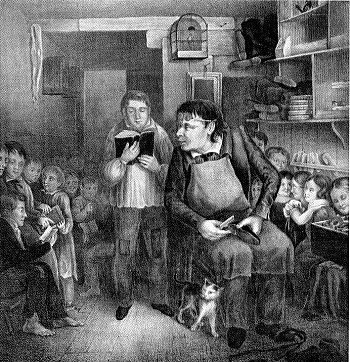
The shoemaker’s work … permitted thinking and discussion
while working; his frequent isolation during working hours threw him on his own
intellectual resources; he was selectively recruited from boys with a likely
incentive to compensate for their physical handicaps; the training of
apprentices and the tramping of journeymen exposed him to the culture of the
trade and to the culture and politics of a wider world….
Sadly, without diaries, letters or reminiscences, we will never know what our local shoemakers thought and did.
Christopher


